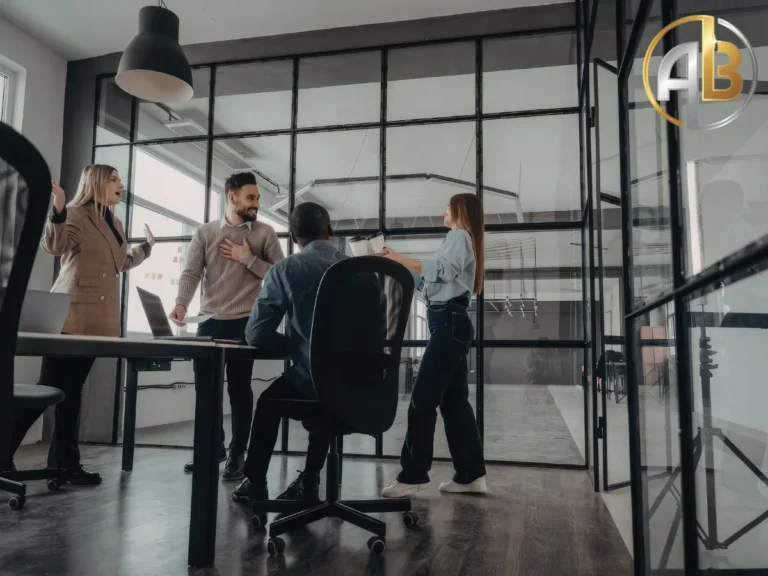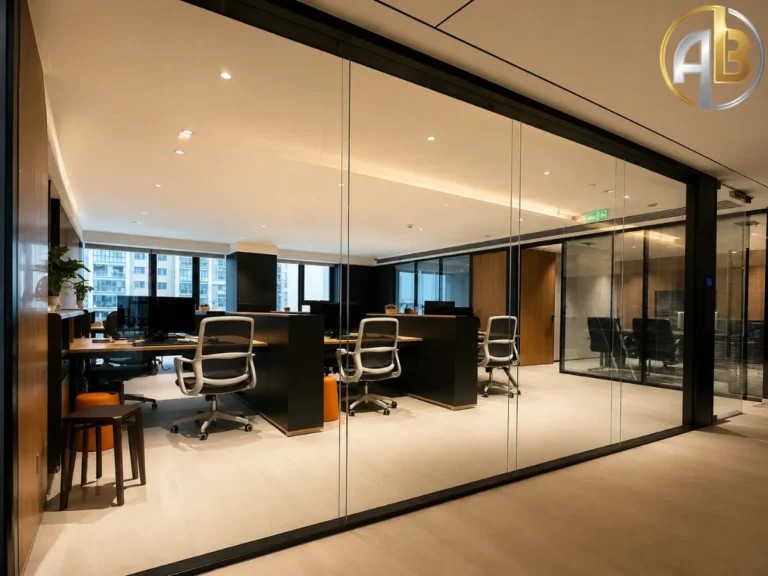

Walk into any newly fitted office in DIFC, Business Bay, or JLT today and you’ll notice one thing immediately: you can see through most of the building. The era of plasterboard corridors and closed cellular offices is firmly over in Dubai’s commercial market. Glass partitions are now the default specification for modern office fitouts — and not just because they look good.
There are real, measurable reasons why design-conscious businesses across the UAE are choosing glass over traditional walling. Here are the seven that come up most consistently in our conversations with clients.
1. Natural Light Goes Deeper Into the Floor Plate
This is the most immediately tangible benefit and the one that gets talked about most. Dubai buildings get extraordinary natural light — and traditional solid partitioning blocks most of it from penetrating beyond the perimeter offices.
Glass partition systems allow daylight to travel through multiple zones of an open plan floor, reducing dependence on artificial lighting and creating a significantly more pleasant working environment. Multiple credible studies on workplace wellbeing confirm the direct link between natural light exposure and productivity — but frankly, you probably don’t need a research paper to know that working in a bright, naturally lit space feels better.
In practical terms, you can also see meaningful reductions in electricity costs if natural light is replacing artificial lighting across a substantial portion of the day.
2. Acoustic Separation Without Visual Separation
One of the biggest objections to open-plan offices is noise. Glass has a reputation for being acoustically transparent — and with basic single-pane systems, that’s fair. But modern double-glazed or acoustic glass partition systems genuinely do perform.
For meeting rooms, executive offices, or phone booths within an open floor plate, a properly specified acoustic glass partition with appropriate frame sealing achieves sound reduction levels (typically Rw 35–45 dB) that are more than adequate for a professional environment. You get the visual connection and light while maintaining acoustic privacy where it matters.
The key is in the specification — this is not a place to cut costs on glass thickness or seal quality.
3. Flexibility: The Office Can Be Reconfigured
Fixed plasterboard walls are a permanent commitment. In Dubai’s fast-moving commercial real estate market — where companies expand, contract, and restructure regularly — that permanence is a genuine business risk.
Demountable glass partition systems are designed to be reconfigured without structural work. Panels can be removed, moved, and reinstalled in different configurations. The aluminium framing is modular and reusable. When you move offices, you can take the system with you — it’s a capital asset, not a fitout cost that gets written off on departure.
For businesses on 2–3 year leases (which is typical in Dubai’s commercial market), this reconfigurability is a compelling financial argument on its own.
4. Compliance with UAE Fire & Safety Regulations
This one often surprises people. Glass is not just an aesthetic choice — it can be a compliance one. UAE fire safety regulations for commercial spaces require specific compartmentalization standards, and correctly specified fire-rated glass partition systems meet these requirements while maintaining visual openness.
Fire-rated glass (typically 30 or 60 minute rated) is available in both framed and frameless configurations. If you’re fitting out a commercial space in Dubai and your designer is specifying glass partitions without discussing fire ratings with you, that’s a gap worth flagging. The UAE Fire and Life Safety Code is clear about compartmentalization requirements in occupied commercial buildings.
5. It Projects a Professional Brand Image
In Dubai’s business culture, the physical office environment communicates a great deal about a company. A client visiting a glass-partitioned office in DIFC reads it immediately: this organisation is organised, transparent, and modern.
That might sound like soft reasoning, but in a city where business relationships are as relationship-driven as they are here, the impression your office creates during a client visit genuinely matters. A well-designed glass partition fitout communicates confidence and competence before a word is spoken.
This is particularly relevant for financial services firms, law practices, consulting businesses, and any company where the office is a sales and relationship environment, not just a working space.
6. Management Visibility Without Micromanagement
An interesting dynamic that comes up regularly with business owners and managers: glass partitions create a culture of visible accountability without the oppressive feel of surveillance.
In a properly designed glass-partition office, senior managers have line of sight to their teams without being physically in the same space. Teams can see whether leadership is present and active. The psychological effect — borne out in multiple workplace studies — is that people tend to be more focused and engaged in environments with natural social visibility.
It’s a meaningful contrast to the isolation of cubicle farms or the chaos of fully open-plan spaces. Glass partitions offer a middle path that many management teams find genuinely productive.
7. Durability and Low Maintenance in UAE Conditions
Aluminium framing doesn’t rust, warp, or swell. Tempered glass panels don’t dent or scratch under normal office use. In Dubai’s climate — where humidity, AC-induced condensation, and temperature swings can punish inferior materials — the combination of aluminium and glass is genuinely one of the most durable partition systems available.
Compared to drywall (which suffers in humid conditions and requires repainting), timber (which warps), or fabric systems (which fade and collect dust), glass partition systems have a significantly lower maintenance cost profile over a 10-year span. The initial investment is higher; the lifetime cost of ownership is often lower.
What to Ask Your Supplier Before You Commit
- Is the glass toughened/tempered or laminated? (Tempered is standard for safety; laminated is used for acoustic and overhead applications)
- What acoustic performance rating does the partition achieve? Ask for Rw values, not just general claims
- Is the system demountable and reconfigurable, or is it fixed?
- Does the framing come in custom powder coat colours to match your brand palette?
- What’s the lead time from order to installation-ready?
Related Al Basira Services
FAQ: Glass Partitions in Dubai Offices
How much do glass partitions cost in Dubai?
For framed aluminium glass partition systems, expect AED 350–700 per square metre depending on glass specification, frame finish, and system type. Fully frameless or acoustic systems run higher. Get comparative quotes, but be cautious of prices significantly below market — glass quality and frame engineering vary substantially.
How long does installation take?
For a typical office floor plate of 500–1,000 sqm, a glass partition installation takes 3–7 working days with a professional crew. The building must be in a finished state (flooring and ceiling complete) before installation begins.
Can glass partitions be used in residential spaces?
Absolutely. Glass partition systems are widely used in Dubai apartments and villas to define spaces, separate kitchen areas, or create home office zones without blocking light. The same products used in commercial fitouts work well in residential applications.
Are there privacy options for glass partitions?
Yes — frosted, sandblasted, or smart-glass (switchable opacity) options are all available. For meeting rooms, frosted band glass or applied vinyl films allow visual privacy at seated height while maintaining full light transmission above and below.