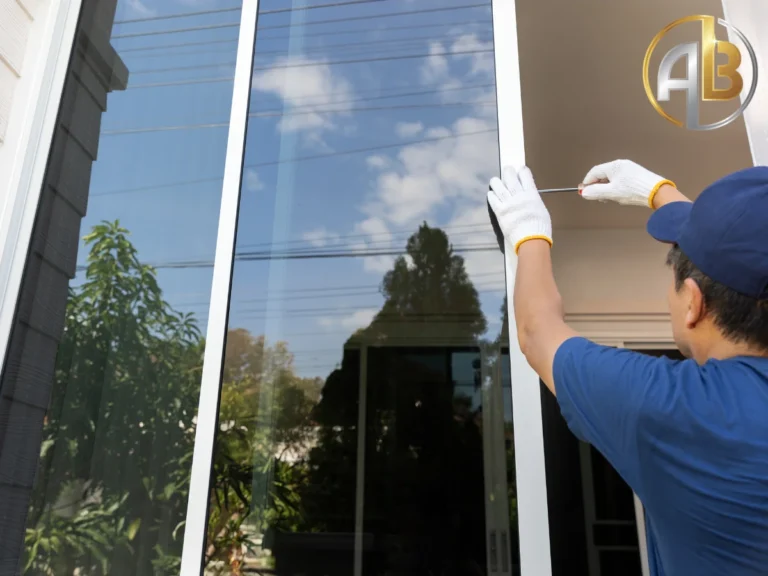

There’s a specific kind of morning that Dubai villa owners talk about. The sun is still low enough that the terrace is cool. The pool is catching the light. The kitchen smells like coffee. And the entire back wall of the living room is open — not a door in sight, just a seamless continuation from interior to exterior, as if the house and the garden have agreed to stop being separate things.
That experience is increasingly being engineered rather than stumbled upon. And the product making it possible, more than anything else, is the slim sliding door.
Over the past few years, minimal-frame sliding door systems have moved from ‘premium upgrade’ to ‘expected standard’ in Dubai’s villa market. If you’re building, renovating, or refurbishing a villa in Emirates Hills, Arabian Ranches, Al Barari, or any of the Palm’s frond communities, your architect has almost certainly already discussed them with you. This article explains why they work so well in the UAE context — and what you need to know to specify them properly.
What Makes a Door ‘Slim’?
The defining characteristic of a slim sliding door system is the profile width — the visible frame between glass panels. Traditional aluminium sliding doors had profiles of 100–150mm. Modern slim systems reduce this to 20–50mm, dramatically reducing the visual interruption between panels.
The result is significantly more glass area relative to frame area. In practical terms, this means more light, wider unobstructed views, and — crucially — a cleaner aesthetic that aligns with modern architectural directions. The frames become almost invisible when the doors are closed and entirely invisible when they’re open.
The engineering challenge is that thinner profiles must still meet structural requirements for wind load, thermal performance, and operational durability. This is where quality variation in the UAE market is most pronounced.
Why UAE Conditions Are Actually Ideal for Slim Sliding Systems
Here’s something that often surprises people: in some respects, the UAE climate is better suited to slim sliding door systems than northern European climates — despite the extreme heat.
The reason is design intent. Slim sliding systems are typically installed as the primary transition between a conditioned interior and a semi-shaded or shaded exterior — a terrace, a covered garden, a pool deck. In Dubai, these outdoor spaces are already thermally managed through pergolas, shade structures, misting systems, and orientation.
When you open the doors into a covered, shaded outdoor space in the evening — particularly between October and April — you’re not fighting the climate. You’re working with it. The indoor-outdoor lifestyle that these doors facilitate is genuinely liveable for eight to nine months of the year in the UAE.
During summer, the doors are closed and the thermal performance of the glazing takes over. With low-E double glazing and the correct SHGC specification for UAE conditions, a slim sliding system can actually have a smaller thermal footprint than a conventional sliding door with poorer-quality glass.
The Spec Details That Actually Matter
Profile Depth and Structural Rating
Thinner profiles look better, but they need to be engineered for the span they’re covering. A 4-panel system spanning 6 metres has very different structural requirements from a 2-panel spanning 2.5 metres. Ask your supplier to show you the wind load calculations for your specific configuration — this should be standard practice, not an unusual request.
Track System: Floor or Ceiling?
Flush-to-floor track systems are the premium specification — no raised track to step over, a truly seamless threshold. They require careful attention to drainage design (the track must slope to allow water drainage in exposed locations) and they need to be coordinated with your flooring contractor.
Ceiling-hung systems eliminate the floor track entirely. Particularly useful for covered terraces where drainage is managed separately, or for interior applications like room dividers. They look spectacular but require the ceiling structure to be assessed for the loading.
Glass Specification for UAE
For the UAE context, the recommended specification is:
- Double-glazed unit with thermal spacer (warm-edge spacer preferred)
- Low-E coating on the interior face of the outer pane
- SHGC of 0.25–0.35 for south and west-facing openings
- Toughened/tempered safety glass as a minimum; laminated inner pane for overhead or high-security applications
Hardware and Seal Quality
The hardware on a slim sliding system takes a great deal of load — these are heavy panels operating on precision tolerances. Stainless steel rollers and tracks, marine-grade hardware for coastal locations, and a weatherseal design that compresses properly when the panels are locked are all non-negotiable for long-term performance.
Poor seals are how Dubai dust gets into your living room. It’s not a minor inconvenience — it’s a daily frustration that compounds over time.
Popular Configurations in Dubai Villas
The Full-Width Opening
The most dramatic — typically 4 to 6 panels spanning 5–10 metres, stacking into one end pocket or splitting into two stacking zones at each end. When fully open, the entire rear wall of the living or dining room disappears. Most commonly specified in villas with covered terraces or pool-facing orientations.
The Corner Opening
Two systems meeting at a structural corner, both opening away from the junction. With the right structural detail at the corner post, this can be almost entirely frameless — the corner column becomes minimal or hidden. The result is an opening that defies the usual sense of interior walls. It’s the specification choice of seriously considered architectural projects.
The Single-Track Divider
For interior applications — separating a living room from a study, dividing a master suite from a dressing area — slim sliding panels on a single track provide acoustic and visual separation on demand. Fully open, they’re invisible. Closed, they define distinct spaces. It’s a flexible solution for Dubai’s larger villa footprints.
Related Services from Al Basira
FAQ: Slim Sliding Doors in the UAE
How do slim sliding doors perform in UAE summer heat?
With correct glass specification (low-E, appropriate SHGC) they perform well. The frame itself, being aluminium with thermal-break, does not conduct significant heat. Most clients find that a properly specified system has no meaningful impact on interior temperature when closed.
What’s the maximum span for a slim sliding door system?
Custom systems can span very large openings, but engineering requirements increase significantly above about 8 metres. For larger spans, the structural design needs to be coordinated between the door supplier and the structural engineer on the project.
How long do slim sliding systems last in Dubai conditions?
A quality system with proper maintenance — annual hardware lubrication and seal inspection — should function reliably for 20+ years. The powder coat on the aluminium should be guaranteed for a minimum of 10 years under UAE conditions.
Can I retrofit slim sliding doors into an existing villa?
Yes, but it requires structural assessment of the opening. The beam or lintel above the opening must be adequate to carry the door load without a supporting column at the opening. In most modern UAE villas this is achievable, but it should be confirmed by a structural engineer before ordering.